
Palms Delivered,
Planted & Staked
Sylvester · Foxtail · Royal · Adonidia · Sabal · Grown at our own nursery
We pick the tree, bring the machine, set it plumb, stake it and clean up behind us. Same crew, same day, from a 7 gallon adonidia to a field-grown royal that needs a real hole.
Rated 4.8★ across 159 verified reviews for design, hardscape & install work throughout Southwest Florida.
We Own the Nursery, So You See the Actual Tree
Most landscapers order palms sight unseen off a broker list and you meet your tree when it comes off the truck. We run our own nursery, Palm & Plant Co, so you can look at the exact palm, compare two of them side by side, and know what the trunk and head look like before it is in your yard. Palm prices by size and species are published there, which is more than most of this market will do.
The install is the half that decides whether the palm is still beautiful in three years. We dig to the root ball, not to a standard hole, set the palm plumb and at the depth it grew at, backfill and berm so water goes down to the roots instead of running off, and stake every field-grown tree while the new roots take hold. Then we haul the spoil off and sweep the drive, because a palm looks worse than it should sitting next to a pile of sand.
Cost follows the tree and the trip. Container palms plant quickly. Field-grown specimens carry real machine and crew time each, and that per-tree cost comes down when several go in on the same visit, so a row or a cluster is better value per palm than a single. Pair the palms with a rock bed or fresh mulch and see it first in a 3D design render.
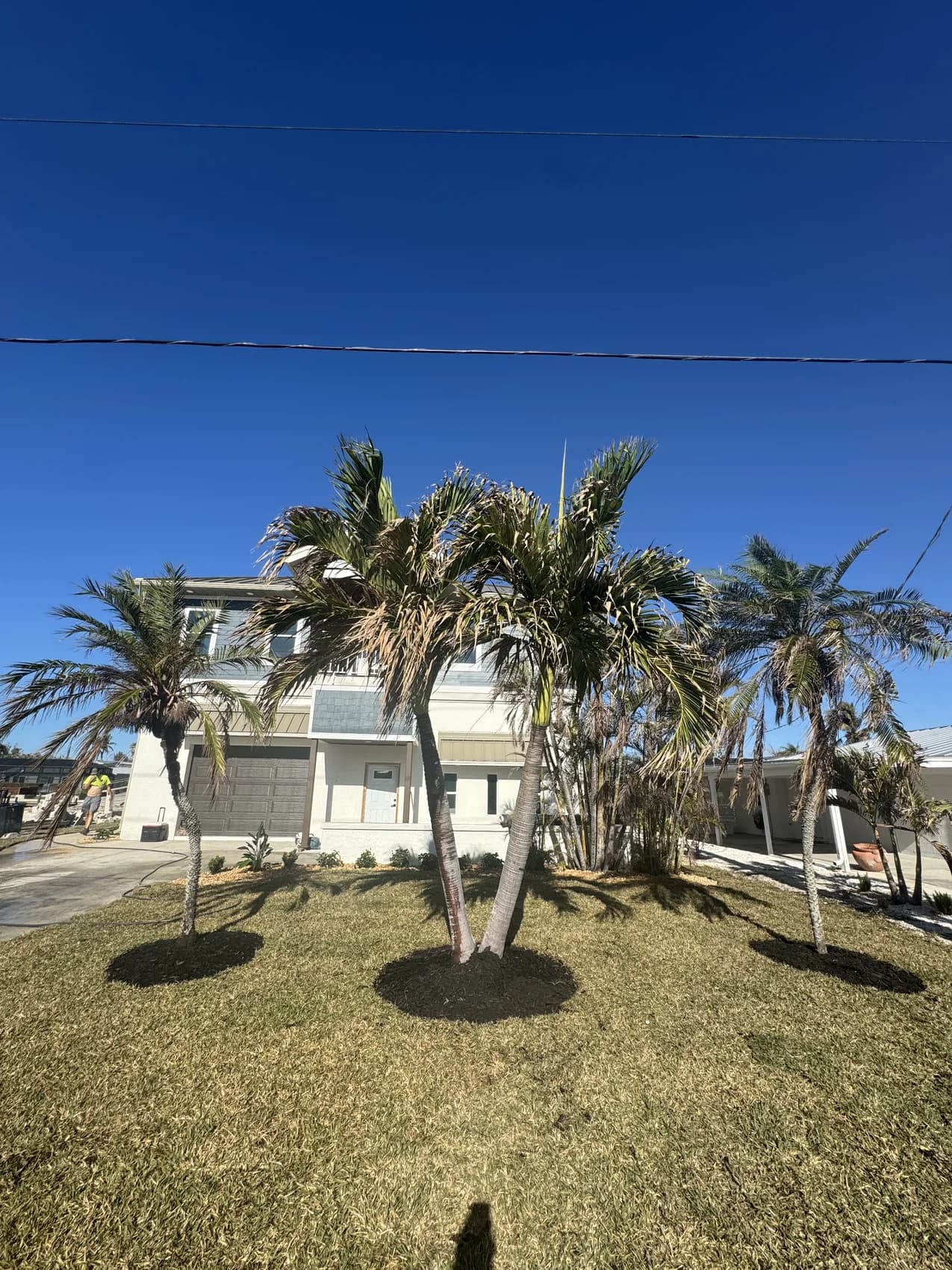
Newly set palms and mulch rings, Cape Coral. Real Blue Collar Q project photo.
Palms We Plant Most
Sylvester date palm
The statement palm. Diamond-cut trunk, formal shape, usually set as a single specimen at an entry or in a pair flanking a driveway. Field grown, so it comes in on a machine.
Foxtail palm
The Cape Coral favorite. Fast, self-cleaning, and it reads tropical without the maintenance of a date palm. Works as a single, a triple, or a run down a fence line.
Royal palm
Big, formal and tall, the palm you see lining boulevards. Best on a lot with room to look up at it. Field-grown royals need a crane or a big machine and a real planting hole.
Adonidia and sabal
Adonidia (Christmas palm) for pool cages, courtyards and tight side yards. Sabal, the Florida state tree, for a native look that shrugs off wind and salt.
Availability moves with the season. Current stock, sizes and published palm prices live on palmandplantco.com.
What the Quote Covers
Included with every palm
Quoted separately (never snuck in)
Palm Installation, FAQ
How much does it cost to plant a palm tree in Cape Coral?
Two things set the price: the palm itself and what it takes to plant it. Palm prices by size and species are published on our nursery site, Palm and Plant Co. The install side is driven by the size of the root ball, how far the machine has to travel, and whether the tree needs a crane. Small container palms are a straightforward planting. Big field-grown specimens carry real machine and crew time per tree, and that per-tree cost drops a lot when several go in on the same trip, which is why a row is better value per palm than a single.
What is the best palm for a Cape Coral yard?
For most homes, foxtail. It grows fast, self-cleans so you are not paying to have dead fronds cut out every year, and it fits a normal lot without outgrowing it. Sylvester date palms are the formal entry statement. Adonidia fits tight courtyards and pool cages. Sabal is the native that handles wind and salt best. On a canal or Gulf-access lot, salt tolerance moves up the list and we steer accordingly.
Do new palms need to be staked?
Every field-grown palm we set gets staked, and so do larger container trees. A palm has no taproot to hold it while the new roots take, so wind rocks it, the root ball breaks contact with the soil, and the tree stalls or leans. Staking holds it still through that window. We remove or check the bracing on follow-up visits rather than leaving wood strapped to a trunk forever.
When is the best time to plant palms in Southwest Florida?
Late spring through summer is ideal, because warm soil plus the rainy season is exactly what a palm needs to push new roots. That said, we plant palms year round in Cape Coral and the winter-planted ones do fine with more attention to watering. What kills new palms here is almost never the month. It is watering, either too little in the first six weeks or a sprinkler zone that was never checked after install.
Can you move a palm I already have?
Sometimes. Relocating a palm depends on species, size, and whether a machine can reach both the old and the new spot. Some palms transplant well at size and others rarely take. We look at it on the walk and give you a straight answer about the odds before you spend anything, instead of moving a tree that was never going to make it.
Get Your Palm Install Quote
Free on-site walk anywhere in Cape Coral, Fort Myers and SW Florida. Tell us the look you want and we will match it to trees you can come see.
Plants, Beds & Design
Related Articles
- Best Tree Trimming Companies in Cape Coral, FL - What to Look For
- Bonita Springs HOA-Approved Tree Trimming - Expert Guidance for Homeowners
- Stump Removal Tips for Naples Homeowners: Handling the Climate and Soil
- Choosing the Right Tree Trimming Company in Bonita Springs: A Guide to Healthy Trees and Beautiful Lawns
- Stump Removal Tips for Cape Coral's Climate and Soil
- When to Remove Stumps in Fort Myers, FL: Timing for a Healthy Lawn
Nearby Service Areas
Ready to Put Real Palms In?
Free on-site walk, trees you can come look at, written quote.